Quick answer
School readiness does not have to feel like homework. Simple play can help preschool children practise focus, fine motor control, early literacy, counting, independence and confidence. Start with five to ten minutes and stop while the experience is still positive.
| Activity | Main skill | Other skills | Age guide |
|---|---|---|---|
| Pom pom sorting | Fine motor | Colours, focus, coordination | 3-5 |
| Copy the pattern | Visual focus | Memory, problem solving | 3-5 |
| SATPIN sound game | Early literacy | Listening, speech sounds | 4-6 |
| Count toys 1-10 | Early numeracy | Attention, instructions | 3-5 |
| Routine practice | Independence | Sequencing, confidence | 3-7 |
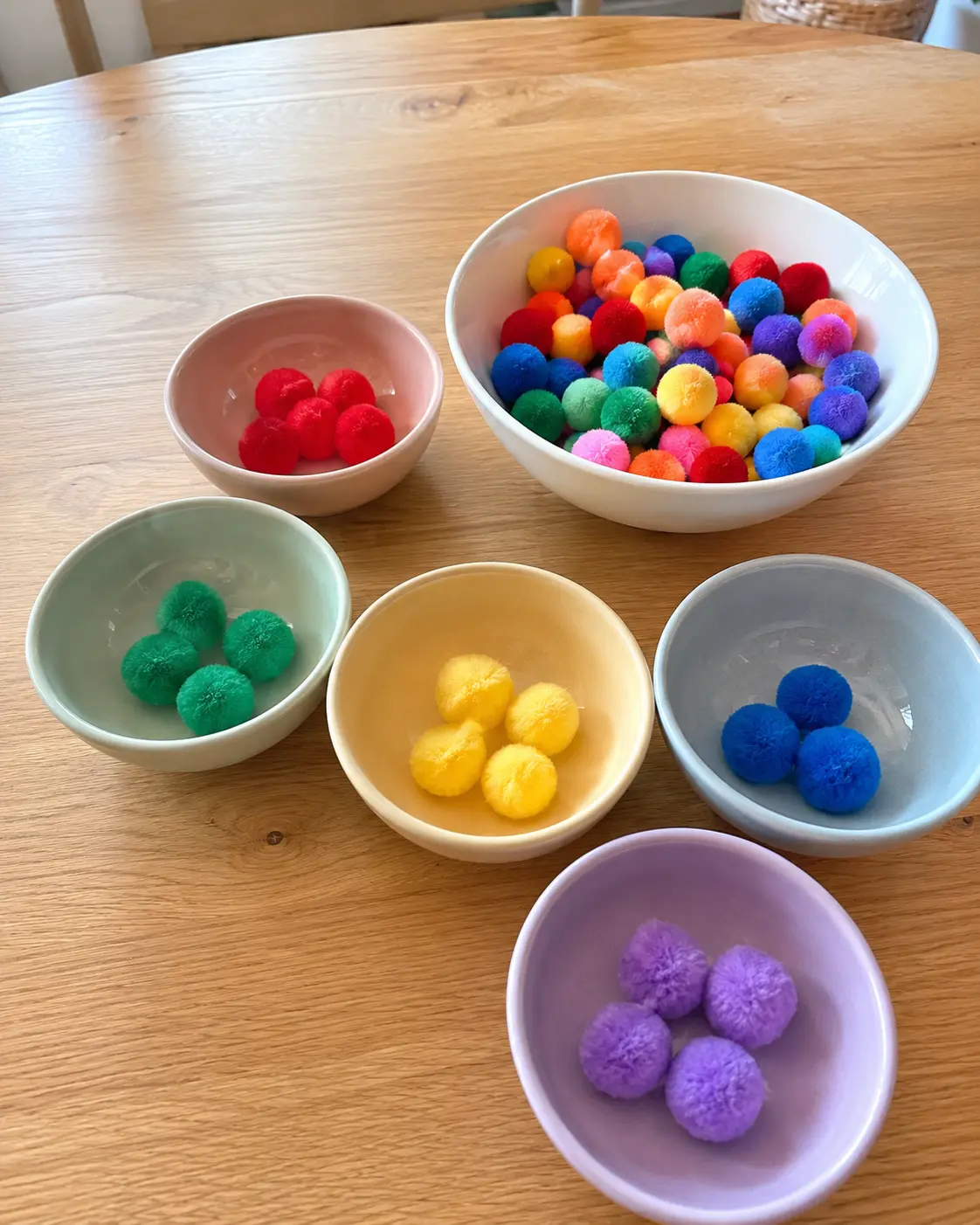
1. Pom pom colour sorting
Place a mixed group of pom poms beside two or more bowls. Ask the child to sort by colour. Fingers are perfectly fine; child-safe tongs can be offered when the child is ready.
- Make it easier: use two colours and large pom poms.
- Make it harder: copy a sequence such as red-blue-red-blue.
See the complete Pom Pom Colour Sorting Activity.
2. Copy the pattern blocks
Build a short row with blocks, magnetic tiles or coloured paper shapes. Ask the child to make the same row. Begin with two pieces and leave the model visible.
- Make it easier: use the same shapes in two colours.
- Make it harder: hide the model for three seconds before building.
See the complete Pattern Blocks Game.
3. SATPIN letter-sound match
Choose two or three letters from s, a, t, p, i and n. Say a common sound for one letter and match it with a familiar picture: s for sun, a for apple or p for pig.
- Make it easier: offer a choice between two pictures.
- Make it harder: find another object that begins with the sound.
See the complete SATPIN Letter Sound Game.
4. Count 1-10 with toys
Use cars, blocks, toy animals or safe counters. Ask the child to give you three cars or put five blocks in a basket. Encourage touching one item for each number word.
- Make it easier: count 1-3.
- Make it harder: remove one object and count again.
See the complete Counting 1-10 Activity.
5. Morning routine practice
Use a few visual cards and practise at a calm time. Ask “What comes next?” or let the child move a finished card to a Done area.
- Make it easier: show only toilet, breakfast and shoes.
- Make it harder: let the child arrange the cards in order.
Use the Morning Routine Chart.
Parent tip
The goal is not to make a child sit and perform. The goal is to build a small skill through play, repetition and connection. If interest is gone, stop and try another day.
Safety and limits
Choose age-appropriate materials and supervise closely. Pom poms and small counters can be choking hazards; scissors and water need specific adult supervision. These activities provide practice opportunities, not a test or guarantee of readiness.
Related resources
Frequently asked questions
What age are these activities for?
They are mainly for ages 3-5, with simple adjustments for younger or older children.
Do the activities need to be academic?
No. Attention, movement, communication, independence and confidence are also important.
What if my child does not want to join?
Offer two choices, simplify the task or come back later. Avoid forcing play.